



Procurement's AI Playbook





Your CEO just asked for your AI plan. Your CFO wants to know what procurement is doing with AI. It came up at the last board meeting. If you lead procurement, these questions are on your desk right now, and the honest answer for most teams is still a shrug.
I understand the hesitation. A year ago the technology was not ready, and it moves fast enough that waiting feels safer than betting. That instinct is now the risk. The space is finally defined enough to act on, and it is still early enough to get ahead of everyone who is waiting for permission.
The data backs this up. BCG's AI at Work 2025 survey found that more than three-quarters of leaders and managers use generative AI several times a week, while frontline adoption has stalled at 51%. Only one-third of employees say they have been properly trained. The tools are here. The skills are not. That gap is the opportunity, and it is where I want procurement leaders to focus.
Here is what I believe: the AI playbook has already been written for nearly every other function. IT deployed copilots. Sales automated pipeline scoring. Customer success runs AI-powered onboarding. Procurement does not need to invent something new. It needs to run the play, and I think it comes down to three pillars.
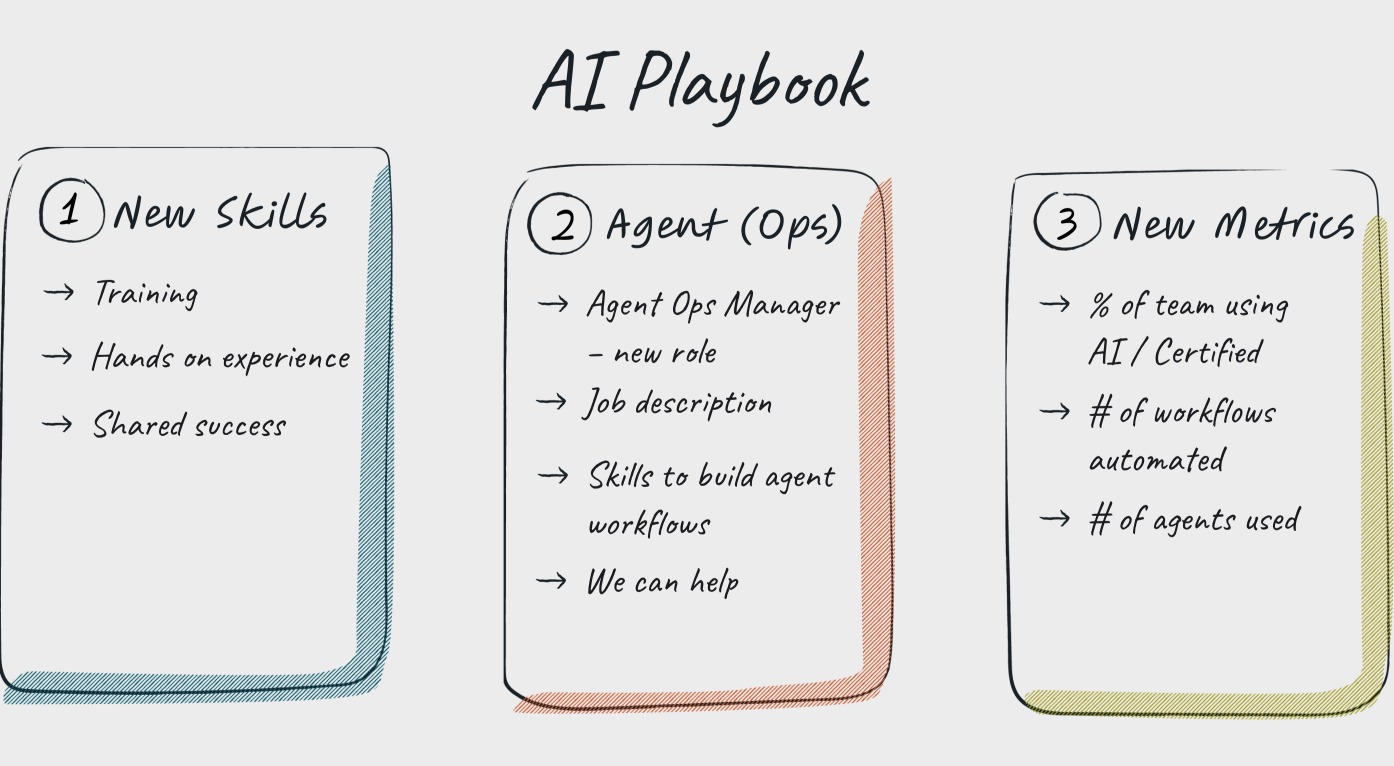
Skills come before tools
Most teams start their AI journey with a purchase. The teams that scale start with people. Give your current team the ability to use AI every day, and most of the value follows.
Curiosity is not the barrier. Access and comfort are. Many teams have no approved tools, and the ones that do often lack the prompt literacy to get real value from them. Fixing that is not complicated. Run a 90-minute internal session on AI fundamentals for procurement: what the tools do, what they do not, and where they fit existing workflows. Then give every person an approved tool and one real task this week. Draft an RFP section. Summarize a supplier proposal. Build a comparison matrix. Once someone gets a genuinely useful result on real work, skepticism turns into curiosity.
Make the wins visible. When someone cuts a process from four hours to forty minutes, that story belongs in your next team meeting. A shared channel of prompts, results, and lessons becomes a procurement-specific library worth more than any generic list of prompts online. When your CEO asks what the team is doing, you answer with specifics: we trained everyone, this percentage uses AI weekly, and here are three places it already saved us time.
Someone has to own the agents
Most procurement teams have a systems person, often called Procurement Ops, who keeps the stack running and configures workflows. That role now needs a counterpart I would call Agent Ops.
Procurement Ops configures a system so the right form appears when a user clicks a button. Agent Ops designs, builds, and monitors AI agents that handle entire process steps on their own: reviewing contracts against playbooks, scoring supplier responses, routing approvals, and flagging renewal deadlines. Building agents is a different discipline from configuring software. It means knowing which decisions can be automated, which need human judgment, how to set guardrails, and how to measure whether an agent is actually performing.
You do not need to hire a VP of Agent Operations tomorrow. Start with the person already gravitating toward this work, the one building automations and asking what else could be automated. Give them the mandate, the time, and the resources, then pick one high-volume, low-complexity process and automate it. Contract review against standard terms. Supplier qualification screening. Purchase request triage. Your first agent does not need to be sophisticated. It needs a real, provable outcome, because that first win funds everything after it. Without this function, agents stay one-off experiments that nobody maintains, and the promising bot from Q1 is forgotten by Q3.
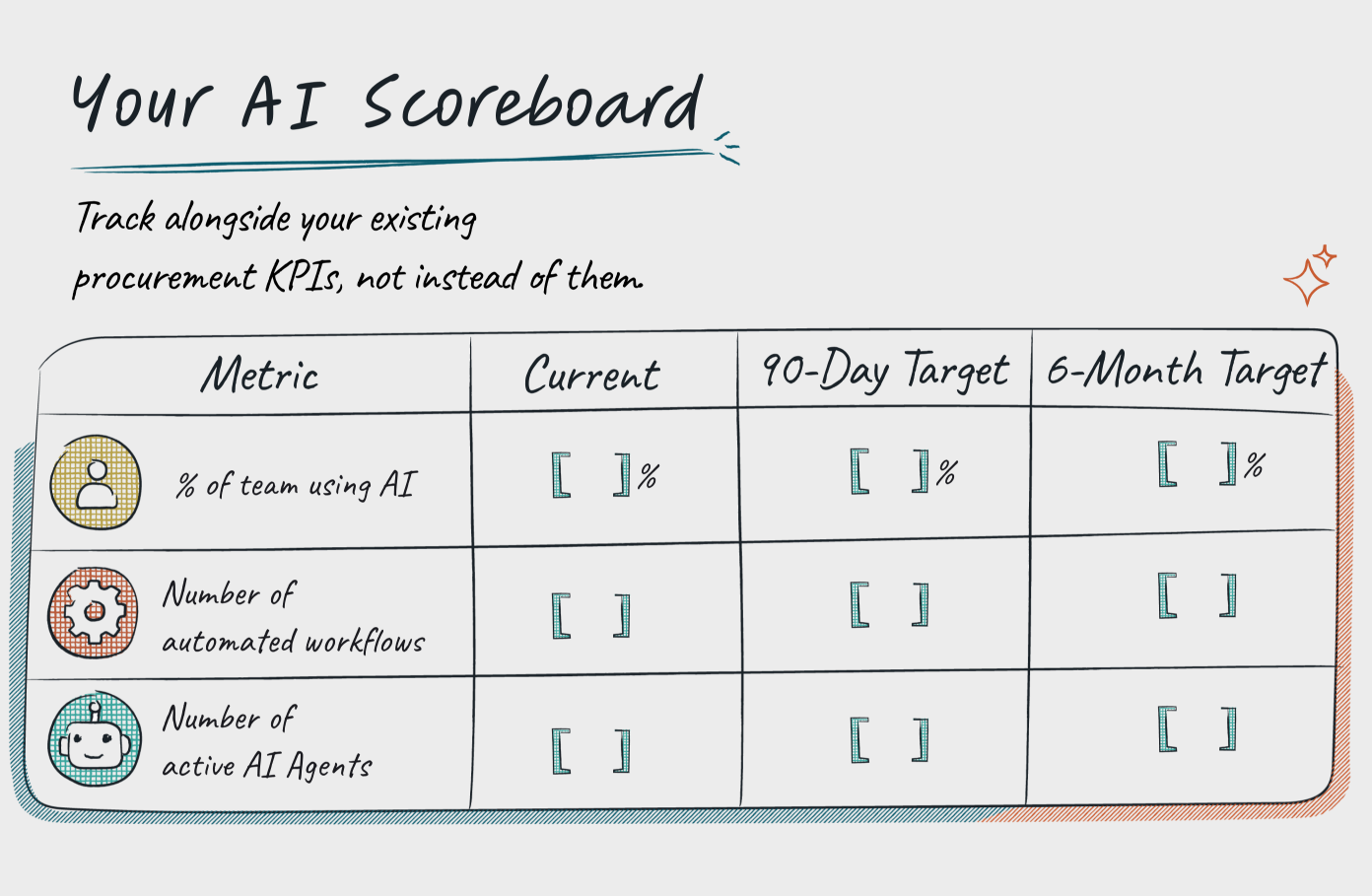
Measure what leadership can see
You cannot run a playbook without a scoreboard. McKinsey's recent analysis of procurement in the agentic AI era makes the case that successful transformations pair technology with operating-model redesign, new KPIs, and strong change leadership. The right metrics here are deliberately simple, and I track three.
Percentage of the team using AI, regularly, not once a quarter for a demo. Number of workflows automated, each one a compounding investment that saves time every time it runs. Number of active AI agents live and handling real work in the last 30 days, because an agent that was built but never used does not count. These sit alongside savings, spend under management, cycle times, and compliance. Traditional metrics prove the work. The new ones prove you are building capability.
Start now, not next quarter
The companies that separate themselves over the next year will not be the ones with the biggest AI budgets. They will be the ones that treat AI adoption as an operational discipline: structured upskilling, a dedicated function to build and manage agents, and KPIs that create accountability from the executive level down.
These three areas feed each other. A team comfortable with AI starts spotting automation. More automation creates more data to measure. Better metrics make a stronger case for leadership to keep investing. There is no universal playbook you can copy, and that is exactly why now is the moment to build your own.

