



What It Takes to Make Procurement's Value Real
Understand the value you are not capturing
Most people find out about the hard part of a job after they take it. I was told in the interview. Procurement at International Paper had been operating in its own silo, and credibility with the business was a concern. Even if they hadn’t been so honest, I wouldn’t have been shocked.
I’ve worked at many places where the same pattern repeats itself: procurement works on its own, signs the contract, tells the stakeholder how much the deal saved, and then hands the details off to someone else for execution. Announcing the savings is the easy part. Making them real in the P&L is where the work actually is.
The clearest evidence was the savings that never reached the P&L. Direct materials were fairly straightforward to track. The gap was in Maintenance, Repair, and Operations, where procurement was creating real savings, somewhere between $25M and $50M a year, that never made it to earnings before interest and taxes (EBIT) because we had no way to capture it.
This problem is not specific to International Paper. Nearly every procurement team struggles to track its actual value, and there is no easy button to fix it.
Simplify the process, then fix the reporting
I inherited a 20-year-old SAP system and hundreds of Power BI reports. There was plenty of data. Very little of it connected, and very little of it held up under scrutiny. So we simplified. We cut the sourcing process from 21 steps to four, with lighter subtasks inside each step, and took the policy document from more than 50 pages to about 10. That made us faster and gave the team room to use judgment instead of a checklist to follow.
Accurate, reliable reporting was not a clean-up effort. It was the foundation. Without it we could not prove what we delivered, and value that cannot be proven does not get counted.
Build a new team structure
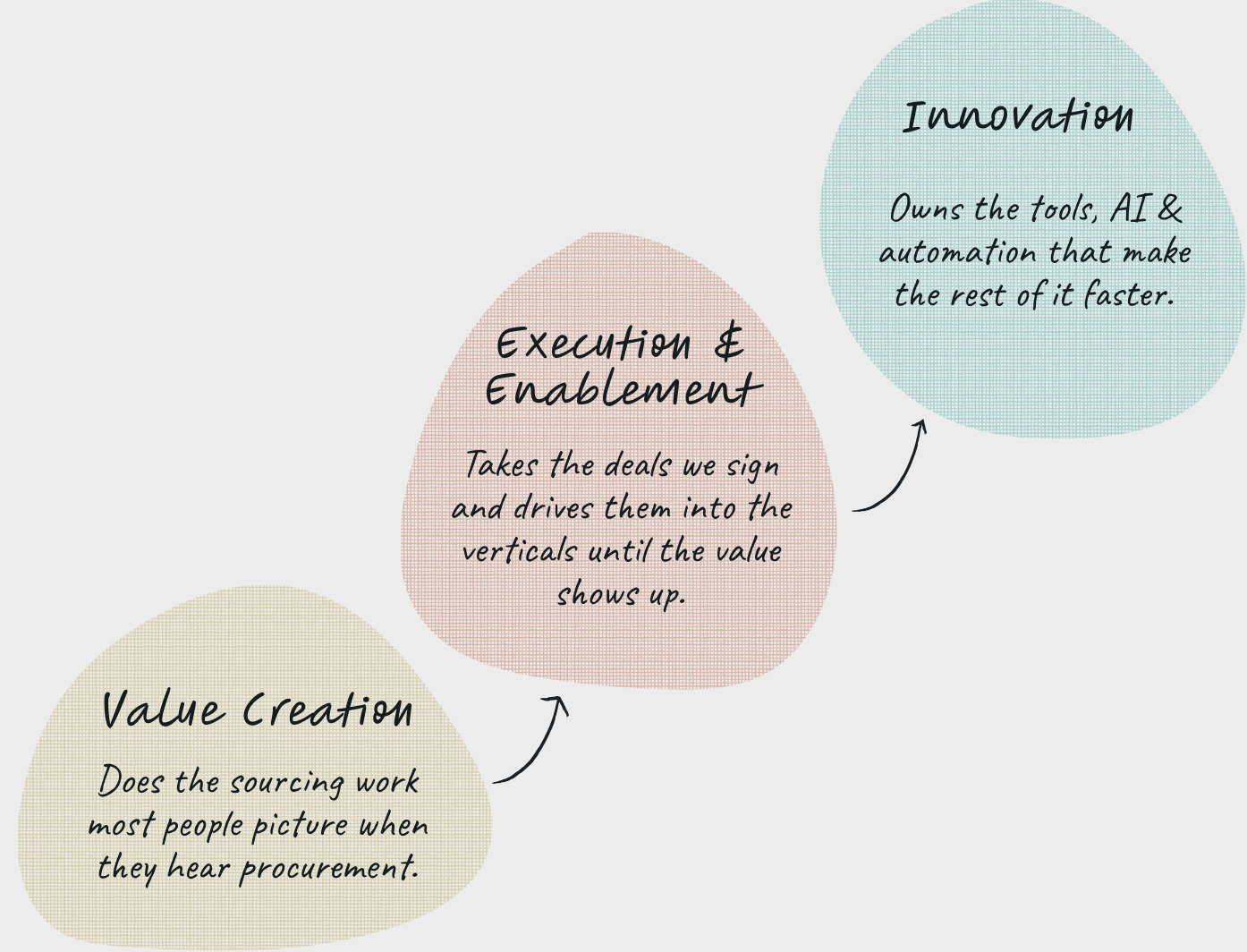
A new process calls for a new team structure, so we reorganized procurement into three groups: Value Creation, Execution & Enablement, and Innovation. Value Creation does the sourcing work most people picture when they hear the word procurement. Execution & Enablement takes the deals we sign and drives them into the verticals until the value shows up. Innovation owns the tools, AI, and automation that make the rest of it faster. Together they close the loop, from finding value to landing it.
Execution & Enablement was the hardest of the three to stand up. Procurement had never been involved in execution here, so it was an entirely new motion for the team and for everyone we worked with.
I spent a lot of time with the peers who run each vertical the E&E team would touch. They had to see the value themselves, because that was the only way it would work. Then I went a level down and had the same conversations. Buy-in from a vertical leader that never reaches their team does not survive the first project.
I had never built a team like this before, at any company. It was clear to me that International Paper needed one. In the end, what made the case was not the case. It was the work. Several of the peers I had to work hardest to convince have since come back to tell me how much value they are getting from the team.
Presence is half the battle
Once the team established real presence with our stakeholders, the wins got concrete. We recently ran a project on pallets at a group of our sites and sent the E&E team out to talk to the site leadership and transportation teams in person.
The specs came back changed and the new pallet cost less. The more important outcome was that the site team stopped seeing procurement as something being done to them. They could see they were not giving anything up by working with us.
Being on the ground opened the door to more strategic work. Now some of the vertical leaders come to us first, and the questions have changed. They ask:
- Where can we find savings in my category?
- How do we do more of this, faster?
- If we moved from an A pallet to a B pallet, what would that actually mean?
We have a major initiative underway in Integrated Facilities Management, a category that covers hundreds of millions of dollars in spend. Because of these new relationships, 26 sites asked to join the pilot. We had more volunteers than we could take.
Procurement usually shows up at the end of the process, after the decision is already made. Getting in front of that decision takes more than strategy. It takes relationships and a steady record of wins.
There are no silver bullets
I don’t think we’ll find a silver bullet for procurement. There is not much out there that someone hasn’t already thought of or tried. AI will help, though, both with efficiency and with the depth of our analysis. It will change how procurement buys. It will not invent new things to buy.
At International Paper, we are implementing tools that come with AI built in, and we’ve brought in Claude and connected it to our existing tools and data sources. Some people are leaning in hard, running deeper analysis and bringing back better answers than they could have produced before. As with any new tool, adoption is uneven, and we are still working on getting it to scale.
AI will also change what a procurement team looks like on paper. Until recently, it was uncommon for a procurement manager or director to have a data science background. Now it is one of the most valuable things a person can bring, because a team that can prove its own numbers never has to argue for its credibility. It has the receipts.
The tools are only half of it, though. The procurement leaders who will stand out over the next decade are the ones who pair that analytical depth with real emotional intelligence. Data science gets you the answer. Relationships get you invited into the decision before it is made. Given the choice, I will take the person who can do both over a specialist in either one.
You cannot have one success and stop. Procurement does not earn its seat by reporting value. It earns it by realizing value, again and again, until people start showing up to ask for more.

