



Building Procurement with AI from Day One
Start with business outcomes
Across my CPO, operations, and advisory roles, I have seen AI transformation focus on one element—the operating model, technology, or people—while giving less attention to the others. In my view, the strongest approach brings all three together. It starts with the outcomes the business needs, then examines the real work and the right talent required to deliver them. Why do we need this step? What decision does it support? Could we shorten the process while preserving the controls that matter? What would allow us to respond faster? These questions should shape the function before we settle on its workflows and technology.
Design the team for an end-to-end flow of work
Building the new indirect procurement organization at Cognex has given me the opportunity to design the operating model, source-to-pay technology, and people’s responsibilities together from the outset. We start with business outcomes, question traditional process steps, and design for a connected flow of work as the function takes shape.
Many established functions face a different starting point: existing systems, processes, and responsibilities that need to be connected and made more effective. Building a new one creates room to question those design choices earlier and consider what the business really needs. A function designed around AI from the start and a function with AI added at the end produce very different org charts.
Understanding how work moves across a function—and how it affects business outcomes—is essential to the design. AI agents and assistants create opportunities to connect data, shorten processes, and support decisions, but the operating model must define how that support fits into the workflow, where human judgment is needed, and who is accountable for the outcome.
As a broader example of where agents could contribute, some repeatable work may be suitable for an AI agent to manage from start to finish within clearly defined boundaries. Low-dollar, low-risk indirect purchases and routine negotiations can follow consistent steps and decision rules. For years, much of that spend has flowed through corporate cards or third-party consolidators. An agent could research the market, compare offers, and execute an authorized purchase within approved limits, escalating exceptions for human review. Used well, it can perform many of the essential tasks of a junior buyer, with people providing oversight and remaining accountable.
The business value lies as much in timing as in the hours returned. Sourcing decisions create value while there is still an opportunity to influence the outcome. Giving routine purchases timely attention can help teams capture opportunities that might otherwise pass while waiting for someone to become available.
A traditional workflow may still serve an essential purpose, even if the way we perform it can change. Leaders need to understand that purpose, challenge unnecessary effort, and design a simpler path to the required decision. Connected technology becomes more useful when the process around it has been thought through.
Bring operating experience to the design process
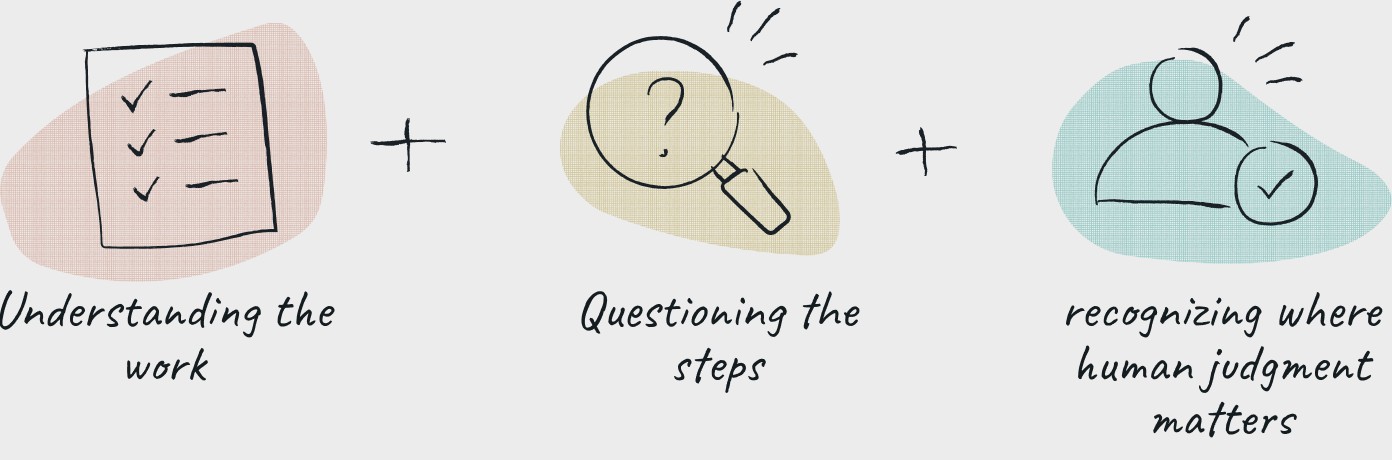
My career has taken me through strategic sourcing, category management, supplier management, procurement operations, and centers of excellence. As an Interim and Fractional CPO, I have drawn on that hands-on experience to lead procurement transformation. It shapes how I approach AI: understanding the work, questioning the steps, and recognizing where human judgment matters. To redesign a job well, you need to understand what it takes to do it.
Give young professionals a meaningful role
The human dimension deserves the same attention as the process and technology. Graduates and young professionals need to see a place for themselves in procurement as AI becomes part of everyday work. I look for curiosity, adaptability, ownership, and the confidence to ask questions. Familiarity with the tools matters, along with the ability to learn and understand the business. Knowledge of a specific model has a shelf life measured in months. Curiosity and judgment do not expire.
As Vice Chair of the Board of Visitors and advisor to the Data Science and Supply Chain programs at Wayne State University’s Mike Ilitch School of Business, I often think about how students prepare for this new environment. My work chairing the Digital Innovation Committee at the Institute for Supply Management brings that question to the forefront. If entry-level analytical work is the first thing an agent absorbs, the traditional first job in procurement is changing. We need to prepare people to take a proactive role while being supported by AI.
Being the human in the loop requires more than approving an output. Young professionals should be encouraged to ask whether an answer makes commercial sense, what assumptions sit behind it, and what information might be missing. Real supplier exposure, business problems, and responsibility for decisions help build that judgment. Leaders need to create opportunities for them to question AI outputs openly and learn from the consequences of a decision.
Connect the operating model, technology, and people
These choices depend on one another. A simpler workflow changes what technology needs to support. Connected technology changes what people can do and the information available to them. People need the skills, authority, and accountability to act on that information. Designing these elements together helps the function turn AI capability into business value.
AI is pushing procurement leaders to be explicit about what we want people to do. We need to decide deliberately which work to automate and where human judgment creates the greatest value.
My vision is a procurement function built around the outcomes the business needs: adaptable processes, connected technology, agents carrying repeatable work, and people applying judgment confidently to the decisions that require it. Building that function takes executive direction, a practical understanding of the function, and a commitment to developing talent.
If you had the opportunity to build your procurement function, how would you bring the operating model, technology, and people together—and which traditional steps would you challenge first?
